- 195-B, Libaspur Road Samaypur, Delhi-110042
Technical Support: (9:00 am to 9:00 pm GMT +5:30)


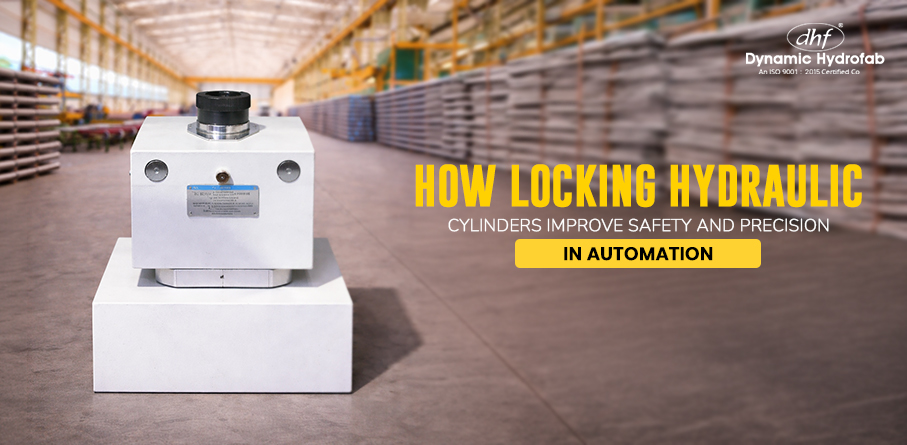
The accuracy and dependability of automation are significantly increased when locking hydraulic cylinders are utilised correctly because they offer a fail-safe mechanical retention of loads. This feature will still work even if the hydraulic pressure is abruptly stopped. In certain situations, they eliminate hydraulic drift, offer precise placement in injection moulding and related applications, and enhance operator safety by eliminating unanticipated and hazardous movements.
These locks are made even more secure at the conclusion of the journey by adding a second lock that can be engaged at any time while in transit. These locks typically have a smaller, perpendicular locking hydraulic cylinder or a spring-loaded cap attached to the cylinder rod end as an installable "head" or collar. Both of these configurations are referred to as "head-head" locks. There are places along the journey when the lock can fit snugly around the rod before an actuator locks it in place. The systems are only capable of handling cylinder pressures up to 2,500 psi typically. Hence they are not suitable for applications requiring higher operating pressures or larger loads. Some solutions are inexpensive and widely accessible and might be effective. It comes only under certain circumstances. The assemblies are used in an effort to avoid catastrophic failure.
These locking cylinders typically incorporate mechanical locks, such as split-collet or friction-based locking mechanisms, to swiftly lock the piston rod in the event that the hydraulic power is cut off. This prevents uncontrollable slipping or sliding of the piston rod.
Locking cylinders retain precise and steady and infinite-position holding over extended periods of time unlike ordinary cylinders that may drift over time owing to fluid leakage. The production process is ensured. It will yield high-quality parts in this way consistently.
When heavy equipment, such as raised platforms or press dies, requires a sturdy holding, they enable the operator to securely help. This makes the maintenance procedure safer.
To stop the pump from continuously maintaining pressure, the system locks in place either mechanically or hydraulically. Energy usage decreases as a result of less wear and strain on seals and possibly other parts.
They are perfect for activities requiring accurate, high-force, and often repeated operations because they offer extraordinary stiffness in certain situations. Numerous procedures, such as die casting and metal shaping, are needed for these movements.
Many pieces of equipment, such as cranes, forklifts, stock pickers, boom trucks, aerial work platforms, testing apparatus, missile systems, industrial presses, oil drilling rigs, and amusement park attractions, use mechanical locking in their hydraulic systems. Mechanical locking is essential for a wide variety of pneumatic clamping cylinders. Dynamic Hydrofab takes these factors into account carefully when making a design.
a.) performance and safety and cost,
b.) timeliness, dependability,
c.)Total cost of ownership over the system's lifetime.
Dynamic Hydrofab happens to add safety features to hydraulic systems. It is necessary to meet the expectations of such projects. Although it is a difficult task. Performance is not inexpensive. It may result in reduced waste and more uniformity in processes and less stress. It is crucial to evaluate the capabilities of any system or component you are thinking about. You might think to add while constructing or altering your pneumatic locking cylinder.

.jpg)



Leave a Comments